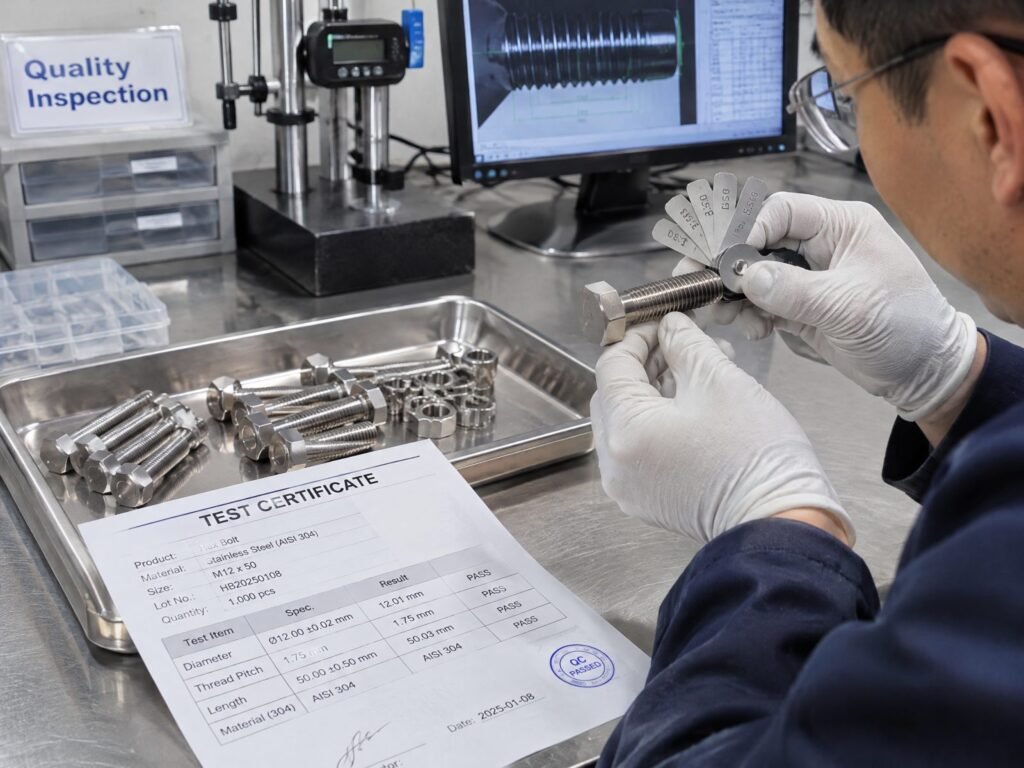
Short answer: German buyers can import DIN and ISO metric stainless steel fasteners from India, but should treat the order like any controlled purchase: specify the exact DIN or ISO standard, property class and marking, agree the dimensional requirement, and ask for the right documents up front. Get these written into the order and surprises are rare.
What DIN and ISO standards do German buyers expect?
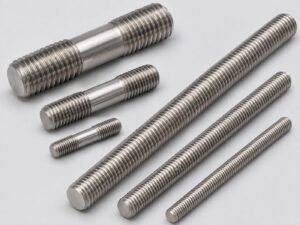
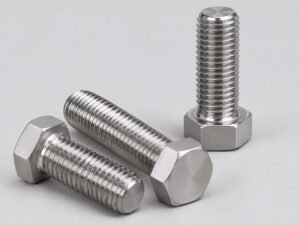
Metric is the default in Germany, and DIN and ISO numbers are the common language. We work to DIN 931/933 for hex bolts and screws, DIN 934 and DIN 975 for nuts and threaded rod, DIN 912 for socket head cap screws, DIN 7991 for countersunk socket screws and DIN 125 for washers, as well as ISO 4014/4017 and ISO 4762. Do not just write the product name; give the standard number, nominal size, length and thread pitch on each line. Where DIN and ISO equivalents exist, state which one you want, since small differences in dimensions can matter in assemblies. See our standards page for the range.
How are A2-70 and A4-80 specified and marked?
ISO 3506 defines stainless groups and strength classes. A2-70 is a common property class for 304-type material, and A4-80 is a common high-strength class in 316-type material. These designations go on the order and, where the product allows, on the head marking. Confirm which class and which marking you need at enquiry. For material background, read about SS 304 fasteners and SS 316 fasteners. Note that a head mark must match the actual material, so keep the property class consistent across your drawing, order and incoming inspection.
What dimensional tolerance should I specify?
Tolerance is where discipline pays. Say which tolerance class or standard governs thread fit and key dimensions, and tell us if any feature is critical, such as head height, thread length or concentricity on socket screws. We make to drawing or sample, so critical dimensions on a drawing are checked against the drawing. Our quality page describes our approach to checking. If you plan to inspect incoming goods, agree the sampling method and acceptance criteria in advance so both sides measure the same way.
Which documents should I ask for?
Standard documents are the commercial invoice and packing list. A certificate of origin can be provided when required, and a material test certificate is available on request. German buyers working under quality systems usually ask for the material certificate on every order, so request it at order stage, not after dispatch. The certificate should be traceable to the supplied lot, so ask how lots will be identified on cartons and paperwork. Fasteners fall under HS heading 7318; the importer or customs broker should confirm current import requirements.
How is the order packed and shipped?
We pack in cartons, palletised or crated, with size, grade and quantity marked on each carton. Separate part numbers or sizes are packed apart and listed line by line on the packing list, so goods-in checks are straightforward. If you need your own part number on cartons, ask at enquiry. Terms can be EXW, FOB, CFR, CIF or DDP, by sea, air or courier. See our export packing and shipping and export pages for the process.
For the regional view, visit supplying stainless steel fasteners to Germany.
How do I set up a repeatable order process?
German procurement teams usually value repeatability above all. Once your first order is accepted, record the exact specification that worked: the standard number, property class, marking, tolerance requirement, certificate format and carton labelling. Quote the same reference on every repeat order so nothing drifts between shipments.
If your drawings change, tell us the revision, and we will confirm the new dimensions in writing before manufacture. Where you need identification by lot, say so at the order stage so that cartons, packing list and certificate can be matched to each other.
It is also worth agreeing how non-conformances are handled before they occur: what you will measure, how you will report an issue and what evidence you will send. A short written agreement of this kind protects both sides and keeps the working relationship straightforward.
Frequently asked questions
Can I order a trial lot to inspect before a larger order?
Yes. Small trial orders are possible, and a trial lot is a practical way to check dimensions, marking and documents against your own requirements.
Do you supply to drawing?
Yes, made-to-order to drawing or sample. Include tolerances and any critical dimensions on the drawing.
Can I get a material test certificate with every shipment?
A material test certificate is available on request. Ask for it when you place the order and state any certificate format you require.
When you are ready, send your requirement for a quotation with the DIN or ISO number, property class, size and quantity, or contact us on +91 89196 74214 or ayrssnutbolt@gmail.com.