
Short answer: Phillips machine screws are the better choice for assembly speed, power tools and production work, because the cross-shaped recess centres the driver. Slotted screws are simple, cheap to tool and easy to drive with a basic screwdriver, but the driver can slip sideways. The head shape (CSK, pan, cheese or round) matters as much as the drive.
What is the difference between a slotted and a Phillips drive?
A slotted head has one straight groove across the top. A Phillips head has a cross-shaped recess with tapered flanks. The Phillips design helps the driver centre itself in the recess, so it is quicker to start and less likely to wander off the screw. A slotted driver can slide sideways out of the groove if pressure is not held perfectly straight, which can scratch the surface around the screw.
What is cam-out and which drive is worse for it?
Cam-out is when the driver rides up and out of the recess as torque rises. A Phillips recess was designed to do this deliberately at high torque, to prevent over-tightening in early assembly lines. That can damage the recess if the bit is worn or the wrong size, which is a common problem in stainless steel because the screw material is tougher and the torque needed is higher. A slotted screw slips out sideways instead. Both drives can be damaged, so the best protection is a correctly sized, good-quality bit or blade, firm axial pressure and not driving at high speed.
Use a Phillips bit of the right size, such as PH1, PH2 or PH3, matched to the screw size. A small bit in a large recess is the most common cause of a stripped head.
Which is faster to assemble?
Phillips. The self-centring recess lets operators and power drivers locate the screw quickly, which suits repetitive assembly, enclosures and electrical panels. Slotted screws are slower to start but are acceptable for one-off jobs, repairs and places where the traditional look matters, such as furniture hardware, instrument panels and heritage restoration. A slotted drive is also easy to clear of paint or dirt, since the slot can be cleaned with a screwdriver blade.
In production, the drive also affects tooling cost and quality control. Phillips bits are widely available and suit automatic feeders and torque-limited drivers, so operators get consistent seating from screw to screw. On the other hand, a slotted screw needs no special bit, which makes it handy for field repairs where you carry only a flat blade. For stainless steel, whichever drive you choose, keep the driver speed moderate and let the screw seat under steady pressure, because stainless generates heat and can gall if it is driven hard and dry.
Which head style should I use: CSK, pan, cheese or round?
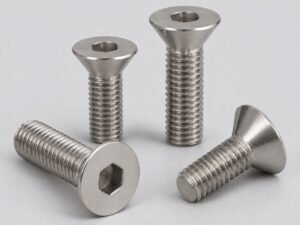
- CSK (countersunk): sits flush when fitted in a countersunk hole. Use it where the surface must be smooth.
- Pan head: a low rounded top with a flat bearing face and good drive contact. This is the general-purpose head for panels and brackets.
- Cheese head: a tall cylindrical head with a deep slot, which gives strong drive contact and is common on instruments and mechanical assemblies.
- Round head: a domed head with a larger dome than pan; used for a rounder appearance and where a visible head is acceptable.
Your choice depends on whether the head must be flush, how much torque is required and how the part will look. If you need a hex socket drive instead, see our stainless machine screws range and the socket-head options.
What sizes do we supply?
In SS 304, our machine screws are available in M2 to M12 for countersunk head and M2 to M10 for pan head, in lengths from 4 to 100 mm. See the product pages for stainless steel slotted machine screws and stainless steel Phillips machine screws.
The SS 304 (A2-70) grade is a good general-purpose choice indoors and outdoors. If your application is coastal or chemical, ask about SS 316. For larger bolt sizes, see stainless hex bolts.
Frequently asked questions
Why do Phillips screws strip so easily in stainless?
Usually a bit that is the wrong size or worn, combined with too much speed and not enough downward pressure. Use a new, correctly sized bit and push firmly while turning.
Are slotted screws weaker than Phillips?
Not in the thread or shank. Strength depends on the size and grade; the head recess affects how much torque can be applied without damage.
Do I need a nut with a machine screw?
Machine screws can go into a tapped hole or be fitted with a nut and washer. Match the thread pitch and the grade of the nut to the screw.
Which head is best for a flush finish?
Choose a countersunk (CSK) head and cut the countersink to match the head angle, so that the head sits level with the surface.
Send us the size, length, drive and head style you need. You can request a quote, call +91 89196 74214 or email ayrssnutbolt@gmail.com.