
Short answer: Choose a button head screw for a low, rounded, neat-looking head, an Allen countersunk (CSK) screw when the head must sit flush with the surface, and an Allen cap screw when you need the highest clamping strength and a deep socket. All three use a hex socket drive, but they behave very differently in the joint.
How do the three head styles differ in profile?
A button head has a low, domed top with a wide, shallow shape. It is smooth, hard to snag on, and looks tidy on visible surfaces such as covers, guards and housings. A CSK (countersunk) head is conical and designed to sit inside a matching countersunk hole, leaving the top face level with the surface. An Allen cap screw has a tall cylindrical head with a deep hex socket, and it sits above the surface unless it is placed in a counterbore.
| Feature | Button head | Allen CSK | Allen cap |
|---|---|---|---|
| Head shape | Low dome | Cone, flush | Tall cylinder |
| Sits on surface | Slightly proud | Flush in countersink | Proud, or in counterbore |
| Socket depth | Shallow | Shallow | Deep |
| Best for | Appearance, safe edges | Smooth, flush faces | High clamp load, tight spaces |
Which one is strongest?
The Allen cap screw is the strongest choice of the three for tension and clamping, because its tall head carries a deep socket and a large amount of material under the head. That lets you apply more torque without rounding the socket. A button head has a shallower socket and thinner head, so it should be used for lighter-duty joints and not for heavily loaded connections. An Allen CSK screw is limited by its conical head and the countersink in the part: the load is carried on the cone, and a poorly cut countersink reduces the strength of the joint.
For stainless steel, the grade matters as much as the head style. Our main grades are SS 304 (A2-70) and SS 316 (A4-70). Always check the property class and the load of your joint against the supplier data, rather than assuming that all heads of the same size carry the same load.
When do I need a flush fit?
Use an Allen CSK screw when something must slide, rotate or sit over the fastened surface: sliding covers, machine guards, access panels, tool fixtures, furniture and anywhere a protruding head would be a hazard or interfere with a mating part. The countersink must be cut to suit the screw angle and depth, so that the head sits level and the cone seats fully. If the countersink is too shallow, the head stays proud; if too deep, the contact area shrinks and the plate material may crack.
Use a button head when a perfectly flush surface is not essential but you want a smooth, low, snag-free appearance without having to machine a countersink. Button heads are also friendly for handled products, since there are no sharp edges.
What sizes and grades are available?
- Stainless steel button head screws: SS 304, M3 to M10, lengths from 6 to 60 mm.
- Stainless steel Allen CSK screws: M3 to M16, in SS 304 and SS 316.
- Stainless steel Allen cap screws: M3 to M24.
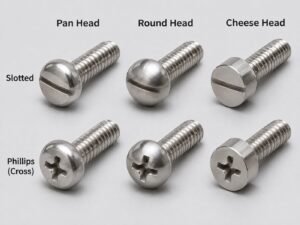
For slotted or Phillips drive options, see stainless machine screws.
How do I tighten socket screws correctly in stainless steel?
Stainless threads can gall if driven fast and dry. Use a hex key or bit that fits the socket fully, tighten smoothly, and avoid impact drivers on small sizes. A touch of lubricant or anti-seize on the thread lowers the risk of seizure, and a worn key is the most common reason sockets round out. Our guide to preventing galling covers this in detail. If the screw is going into a blind tapped hole, make sure the hole is deep enough that the screw does not bottom out before the head seats.
Frequently asked questions
Can I replace an Allen cap screw with a button head?
Only if the joint is lightly loaded. A button head has less strength and a shallower socket, so for structural or high-clamp joints stay with the cap screw.
Do CSK screws need a special countersink?
Yes. The countersink angle and depth must match the screw head so the cone seats fully. Check the head angle on the product page before machining.
Which grade should I choose for outdoor use?
SS 304 suits most indoor and general outdoor use. For coastal, marine or chemical washdown areas, SS 316 is the safer choice because of its better resistance to chlorides.
Are metric Allen screws interchangeable with inch hex keys?
No. Use a metric key sized to the socket. An inch key in a metric socket can look close but will round the socket under load.
Send us the size, length, head style and grade you need and we will respond with the details. You can request a quote, call +91 89196 74214 or email ayrssnutbolt@gmail.com.