
Short answer: For exterior facade, cladding and handrail fixings, SS 304 is usually adequate inland, while SS 316 is the safer choice near the coast, in polluted air or where de-icing salts are used. Fasteners are small compared with the building, but they are hard to replace later, so grade choice should be made at design stage.
Which fasteners are used in facades, cladding and handrails?
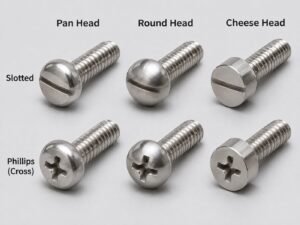
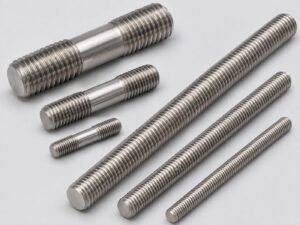
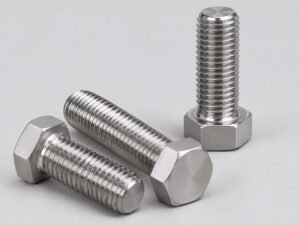
Façade and cladding systems rely on many small fixings holding panels, rails, brackets and support frames in place. Typical items include SS hex bolts and SS hex nuts for bracket and rail connections, washers to spread load on thin cladding, self-drilling or machine screws for sheeting, and threaded rod or studs for anchoring and hangers. Handrails and balustrades add bolts, set screws and fixing studs. Structural connections need fasteners whose strength and dimensions match the engineer’s drawing, so always work from the project specification. You can browse the complete product range in metric and inch sizes. Our construction industry page shows how we support this sector.
Should I use SS 304 or SS 316 outdoors?
Both grades are austenitic stainless steels that resist normal weather. The difference is chloride resistance. SS 316 contains molybdenum, which helps it resist pitting from salt more effectively than SS 304.
| Site condition | Usual starting choice |
|---|---|
| Inland, low pollution, sheltered | SS 304 |
| Urban or industrial air | SS 304 or SS 316, depending on exposure |
| Coastal, marine spray, swimming pool areas | SS 316 |
| Roads or walkways treated with de-icing salt | SS 316 |
Read the detail on our SS 304 and SS 316 pages, and the side-by-side comparison in SS 304 vs SS 316 fasteners. Remember that the fixing should not be the weak link: if the cladding and brackets are designed for a long life, a cheaper fastener grade can become the first thing to fail.
Why do stainless fasteners show brown tea staining?
Tea staining is a brown surface discoloration that appears on stainless steel in coastal or polluted environments, especially on rough surfaces and in areas not washed by rain. It is mostly cosmetic and does not by itself mean the fastener is losing strength, but on visible facades it can look poor. To reduce it, choose SS 316 for exposed locations, specify a smooth, clean surface finish, and plan periodic washing of sheltered areas. Fasteners that are visible to the public deserve extra attention to finish.
How do I allow for thermal movement and avoid galling?
Facade components expand and contract with temperature, and different materials move by different amounts. Aluminium cladding, for example, moves more than stainless steel. Where long rails are fixed, slotted holes or sliding connections let the panel move without loading the fasteners. Using the wrong type of fixing for a movement joint can lead to loosening or fatigue.
Galling is a separate risk. Stainless steel threads can seize when tightened, especially on long fixings and at high speed with power tools. Once galled, a bolt may snap or become impossible to remove. To reduce the risk:
- Tighten slowly rather than at high impact speed.
- Use a suitable anti-seize lubricant on threads where the specification allows.
- Keep threads clean and free of grit and debris.
- Avoid mixing identical hard surfaces without lubrication where possible.
For more detail, see our guide on how to prevent galling in stainless steel fasteners.
What should I tell a supplier before ordering?
To get the right quote, give the supplier the following:
- Fastener type, size, length and thread standard.
- Grade required, and the standard or drawing it refers to. We work with DIN, ISO, BS and ASTM references.
- Site conditions: coastal, industrial, de-icing salt or indoor.
- Whether material test certificates are needed. These are available on request. See our quality page.
- Any non-standard length, head or thread, which we can make to drawing through custom fasteners.
Frequently asked questions
Is SS 304 enough for a facade?
It can be for inland, low-pollution sites. Near the sea, in heavily polluted air or where de-icing salts are present, SS 316 is the more conservative option. Your designer should confirm based on the project’s exposure category.
Does stainless steel need painting or coating on a facade?
Usually not. Its corrosion resistance comes from its own passive layer. Cosmetic issues such as tea staining can still occur, so cleaning and surface finish matter more than coatings.
Can stainless fasteners cause problems with aluminium cladding?
Contact between dissimilar metals in wet conditions can cause galvanic corrosion of the aluminium. Isolating washers or sleeves are often used to separate the metals. Follow the cladding supplier’s guidance.
Can you supply non-standard lengths for facade brackets?
Yes. We make fasteners to drawing, in metric and inch sizes. Send your drawing or sample for review.
Have a facade, cladding or handrail package to price? Send us your list and site conditions and request a quote, or contact us on +91 89196 74214 or ayrssnutbolt@gmail.com.