
Short answer: A thin lock nut, also called a jam nut, is a low-height hex nut used as a second nut against a standard nut. Tightening the two against each other creates friction in the threads that resists loosening. We list stainless thin lock nuts in SS 304 and SS 316 from M5 to M36.
What is a thin lock nut?
A thin lock nut has the same thread and spanner size as a standard hex nut of that size, but its height is roughly half. It is used where a locking action is wanted without special nuts, and where space is too short for two full-height nuts. You will see it on adjusting rods, linkages, turnbuckles, threaded bar assemblies, studs and set positions on machinery.
See our stainless steel lock nuts for the available sizes, and the standard nut that goes with them on our hex nuts page.
How does double nutting work?
When you tighten the first nut and then the second nut against it, the two nuts pull in opposite directions on the same thread. The thread flanks of each nut are pushed against opposite faces of the bolt thread, so even if the joint is shaken, the nuts stay loaded against each other and resist turning. This preloaded friction is what stops the assembly backing off.
The lock works only while the two nuts remain pressed together. If the nuts are not tightened firmly against each other, or the joint relaxes, the locking effect is lost.
What is the correct tightening order?
There are two practices, and the right choice depends on the design. Follow the drawing where one is available.
- Thin nut first, then the standard nut on top. This is the older and widely taught method. The thin nut sits against the part, and the full nut is tightened onto it so that the thin nut carries the locking friction.
- Standard nut against the part, thin nut on top as the lock. This puts the full-height nut where the main clamp load is carried, which is usually the better engineering choice. Tighten the full nut to the required torque first, hold it with a spanner, then tighten the thin nut against it.
In both cases, hold the lower nut still with one spanner while you tighten the upper nut with a second spanner. Tighten the second nut firmly against the first rather than to the full joint torque.
The thin nut cannot carry the same load as a full-height nut, because it has fewer threads engaged. For a joint under significant tension, the full nut should be the one that carries the clamp load.
When are thin nuts used?
- Locking an adjustment: threaded rods and bolts that set a position, such as a stop, a spacer or a tension adjuster.
- Tight spaces: where the projecting thread is short or clearance is limited.
- Reusable locking: a double-nut lock can be released and reset many times, unlike nylon-insert nuts whose lock wears. For a comparison, see our nylock nuts.
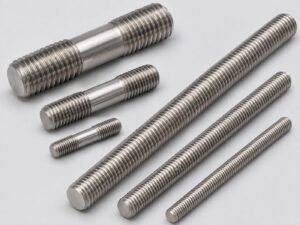
- Making a lock on a stud: two nuts on a stud can act as a drive for fitting it into a tapped hole.
What about stainless steel threads?
Stainless nuts on stainless threads are prone to galling, where the surfaces seize under load and friction. Turn nuts at moderate speed, keep threads clean, and use a suitable lubricant or anti-seize if the application allows. Our guide to preventing galling in stainless steel fasteners gives practical steps. For choosing a grade, see SS 304 and SS 316, or compare them in SS 304 vs SS 316 fasteners.
How do I check that a double-nut lock is still working?
Inspect the joint after the first period of service and at regular intervals after that. Mark the position of the nuts and the thread with a paint pen so any movement is easy to see. Check that the two nuts are still firm against each other: a gap or a nut that turns by hand means the lock has relaxed. If the nuts have been removed and refitted many times, look at the threads for damage or pick-up before relying on the lock again. Where a joint is critical, such as a guard or moving linkage, write the tightening order into the maintenance instruction so every technician follows the same method.
Frequently asked questions
Is a jam nut the same as a thin lock nut?
Yes. Jam nut and thin lock nut are two names for the same low-height nut used as the locking partner of a full nut.
Does double nutting survive heavy vibration?
It improves resistance to loosening, but it is not a guarantee. For severe vibration, inspect joints on a schedule and consider a prevailing-torque lock nut or other locking method.
Can the thin nut be used alone?
Only for light duties where little load is carried. On its own it has fewer threads engaged and should not be relied on for a loaded joint.
Which sizes can you supply?
We list thin lock nuts in SS 304 and SS 316 from M5 to M36. For other sizes or details, see the standards page or ask us directly.
Ready to specify? Send your sizes, grade and quantity through the request a quote page, call +91 89196 74214 or email ayrssnutbolt@gmail.com and our team will respond with a quotation.