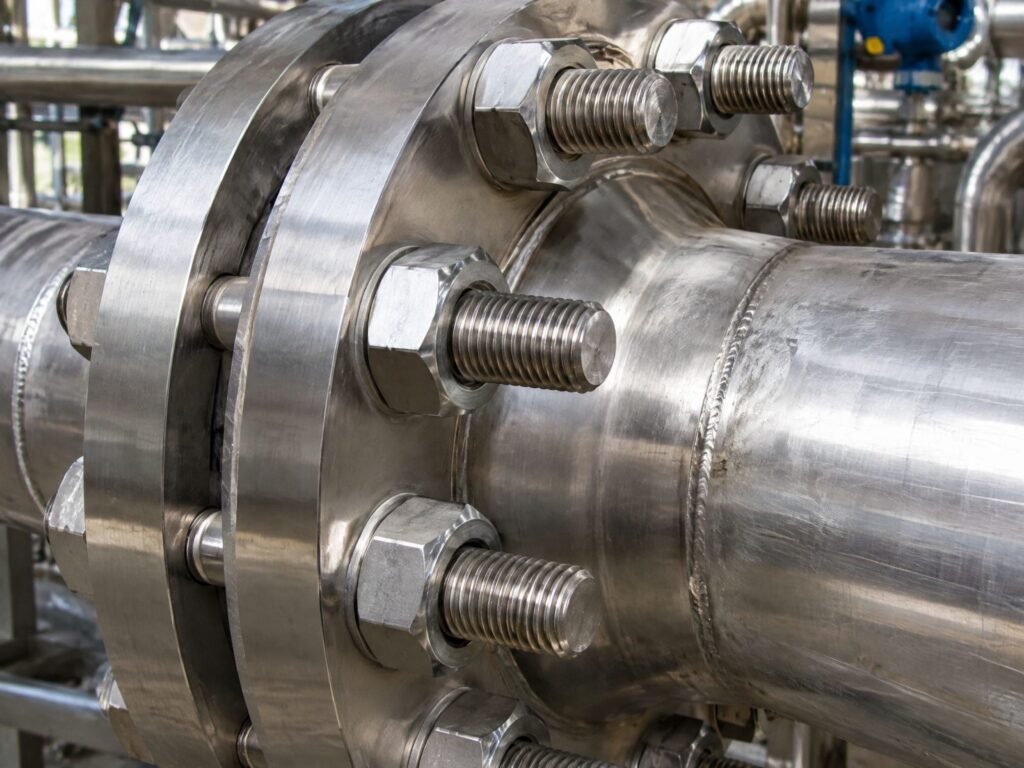
Short answer: Flange bolting in oil and gas is normally done with stud bolts fitted with a hex nut at each end. For stainless service, ASTM A193 B8 and B8M studs with A194 nuts are commonly referenced, with 316-type material preferred where chlorides are present. Always confirm the exact grade, class and standard against the project or piping specification before ordering.
Why are stud bolts used on flanges instead of bolts?
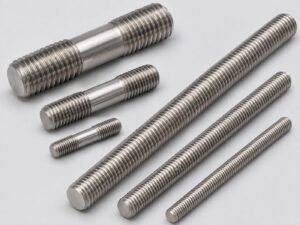
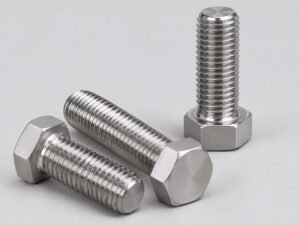
A stud bolt is a fully threaded bar used with two nuts. On a pipe flange, it lets the fitter tighten from either side, spreads load evenly and keeps the assembly consistent across a full bolt circle. Studs are easier to handle in tight spaces and can be replaced without disturbing the opposite side of a joint. Our SS studs page lists what we supply, and hex nuts are covered on the SS hex nuts page. Where a flange design calls for machine bolts, SS hex bolts are available as well. Our oil and gas industry page summarises the sector.
Which standards and grades are normally referenced?
Specifications vary by operator, pipe class and region, so the buyer must confirm what the project calls for. Commonly referenced items for stainless flange bolting are:
| Item | Commonly referenced |
|---|---|
| Studs and bolts | ASTM A193 Grade B8 (304-type) or B8M (316-type), with class stated |
| Nuts | ASTM A194 Grade 8 or 8M |
| Dimensions and threads | As required by the flange standard and drawing |
Note that the class matters. A193 B8 and B8M are supplied in different strength classes, which affect strength and permitted use, so the order must name the class. Do not assume a grade name alone is enough. See our standards page for the references we work with, and treat the project specification as the final authority.
When is SS 316 the better choice?
SS 316 contains molybdenum, which improves resistance to pitting and crevice corrosion in chloride environments. That includes offshore platforms, coastal terminals, produced-water systems and areas exposed to salt spray. SS 304 may be acceptable for less demanding services, but many operators choose 316-type for outdoor flanges. Review our SS 316 fasteners and SS 304 fasteners pages, or the SS 304 vs SS 316 guide.
Temperature and service also matter. Stainless bolting is not automatically right for sour, cryogenic or very high-temperature duties, where the specification may call for other materials or special testing. Rely on your piping engineer for those decisions.
Is DIN 975 threaded rod acceptable for flange bolting?
Use caution. DIN 975 covers general-purpose threaded rod. It is useful for hangers, supports and light fixings, but it is not a substitute for stud bolts made and certified to the pressure-bolting standard the flange specification demands. Cutting threaded rod to length and fitting nuts may look similar to a stud bolt, yet the material standard, strength class, thread fit and traceability can differ. If your specification names A193 and A194, order to those, and do not convert from DIN 975 rod unless the engineer approves it in writing.
What documentation and checks should I ask for?
- Material test certificates showing grade, class and heat number. We provide these on request.
- Markings on studs and nuts that allow matching to the certificate. Ask what marking is applied before ordering.
- Dimensional checks for diameter, length, thread pitch and thread length against your list.
- Any special requirement from the project, such as third-party inspection or extra testing, stated in the enquiry.
For more on our approach, see the quality page. For unusual lengths, thread forms or diameters, we make to drawing through custom fasteners.
How do I write an enquiry that gets an accurate quote?
List every item with grade, class, diameter, thread pitch, length and quantity, and name the standard it refers to, such as the A193 and A194 references above. Say whether the studs are fully threaded, whether any are for special flanges, and whether certificates and marking are needed. If you have an existing sample or flange drawing, send it. Clear information avoids substitutions and speeds up checking on both sides. Where the specification is unclear, raise it with your piping or procurement engineer before ordering, because the supplier cannot replace the project specification.
Frequently asked questions
How many nuts does a flange stud need?
Two, one at each end. Stud length is chosen so that threads show beyond the nut after tightening, as required by the flange standard or your project procedure.
What is the difference between B8 and B8M?
B8 is a 304-type austenitic stainless steel and B8M is a 316-type. B8M offers better resistance to chlorides. Both exist in several classes, so the class must be stated.
Do stainless studs and nuts gall?
Yes, they can. Lubricating threads where the procedure allows and tightening steadily reduces the risk. See how to prevent galling.
Can you supply studs in inch sizes?
Yes. We supply metric and inch sizes and can make to drawing.
Send us your stud and nut list with the specification and grade so we can respond properly: request a quote, call +91 89196 74214 or email ayrssnutbolt@gmail.com.