Short answer: A mill test certificate (also called a material test certificate) is a document that records the grade, chemical composition, mechanical properties and heat number of the steel a fastener was made from. An EN 10204 3.1 certificate is issued by the manufacturer and relates to the actual batch supplied, so it is the one most buyers ask for.
What is a mill test certificate for stainless steel fasteners?
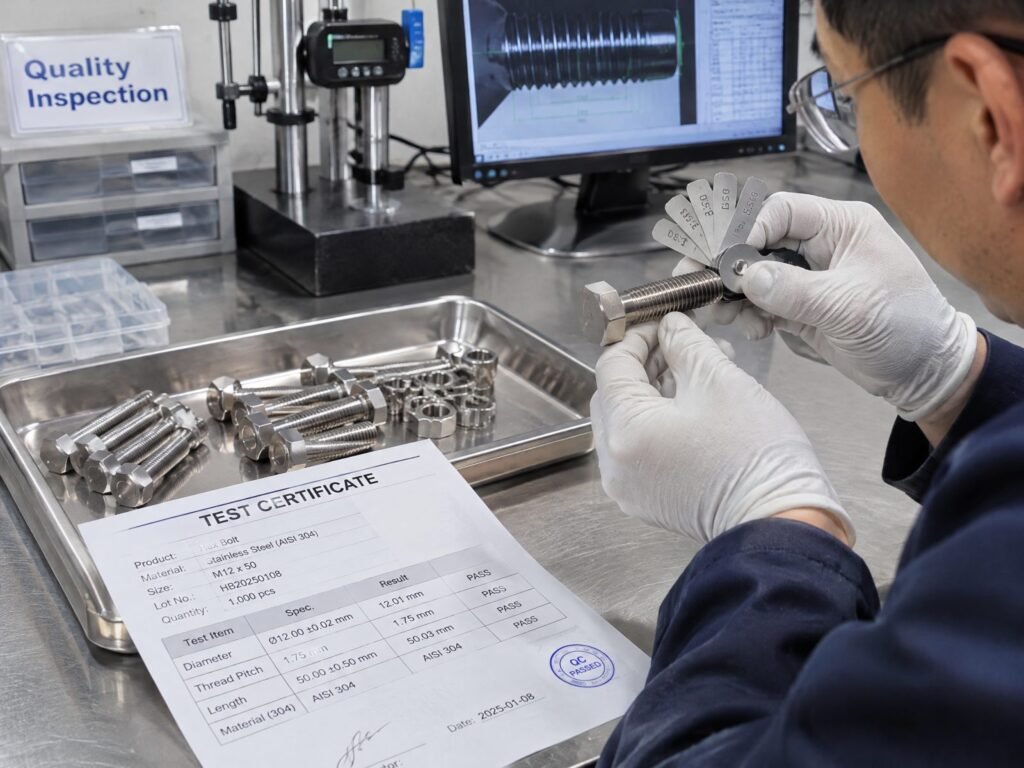
A mill test certificate, often shortened to MTC or MTR, is the paperwork that proves what the material is. It links the finished nut, bolt or washer back to the steel it was made from. For stainless steel this matters because SS 304, SS 316 and SS 202 can look identical but behave very differently in service. The certificate is how you verify that you received the grade you ordered. We provide a material test certificate on request, and you can read more about our checks on the quality page.
What information does the certificate show?
- Grade and specification: for example SS 304 or SS 316, and the material standard it refers to.
- Heat number: the identification of the melt the steel came from. This is the traceability link between certificate and material.
- Chemical composition: percentages of elements such as chromium, nickel, molybdenum and carbon. This is how a 304 is told apart from a 316; molybdenum is the key difference.
- Mechanical properties: typically tensile strength, yield or proof strength and elongation, depending on the material form and property class.
- Dimensions or size of the material, quantity and certificate number, along with the issuer details and date.
What is the difference between EN 10204 3.1 and 2.2?
EN 10204 is the standard that defines the types of inspection documents. In plain terms:
- Type 2.2 is a statement of compliance that includes test results, but based on non-specific inspection. It says the material conforms to the order, using results from the producer’s general process, not necessarily from the exact batch supplied.
- Type 3.1 is issued by the manufacturer’s authorised representative, who is independent of production, and the results come from specific testing of the supplied lot. It is tied to the heat number of your material.
For most buyers, 3.1 gives stronger traceability. It is common to ask for it when material goes into pressure, food, marine, chemical or structural applications, or when your own customer requires batch-level proof. Tell us which type you need when you enquire so the material is handled accordingly.
How do I read a certificate quickly?
- Match the grade on the certificate with your purchase order.
- Check the heat number against the marking or labelling on the packs.
- Look at the chemistry. For SS 316, molybdenum should be present; for SS 304, it should not be a significant element. Compare the values against the limits in the relevant standard.
- Look at the mechanical results and confirm they meet the property class you ordered under ISO 3506.
- Check the quantity, size and date and the issuer signature or stamp.
If anything does not match, raise it before the material goes into production. For grade background see SS 304 and SS 316.
What should I request when ordering?
Say it in the first enquiry, not at dispatch. Include the certificate type you need (for example 3.1), the grade and standard, and whether certificates must be linked to specific batches. If you are buying across several sizes, say whether you want one certificate per item or per heat. Our standards page shows what we work to, and you can send the full list through our contact page or the enquiry form.
Why does traceability matter for stainless fasteners?
Stainless grades are hard to tell apart by eye. A nut made from a lower-alloy steel can pass visually and still corrode early or fail an audit. Traceability, meaning the ability to follow a fastener back to the melt it came from, is what lets you prove the right material was used. If a field problem appears months later, the heat number lets you identify which batch was involved instead of replacing everything.
For the same reason, ask that packs carry the grade and a batch reference where possible, so the certificate in your file and the carton on your shelf can be matched. Keep the certificates with your purchase records, since customers and auditors often ask for them long after delivery.
Frequently asked questions
Is a mill test certificate the same as a material test certificate?
In everyday trade, yes. Both names describe the document showing grade, chemistry and mechanical properties for the steel used.
Does the certificate prove the finished fastener is good?
It proves the material. Dimensional accuracy and finish are checked separately, so ask for dimensional inspection if your application needs it.
Can I get a certificate for small quantities?
Material test certificates are available on request. State the requirement when you enquire so it can be arranged with your order.
Ready to move forward? Send us your details and request a quote, or call +91 89196 74214 or email ayrssnutbolt@gmail.com.