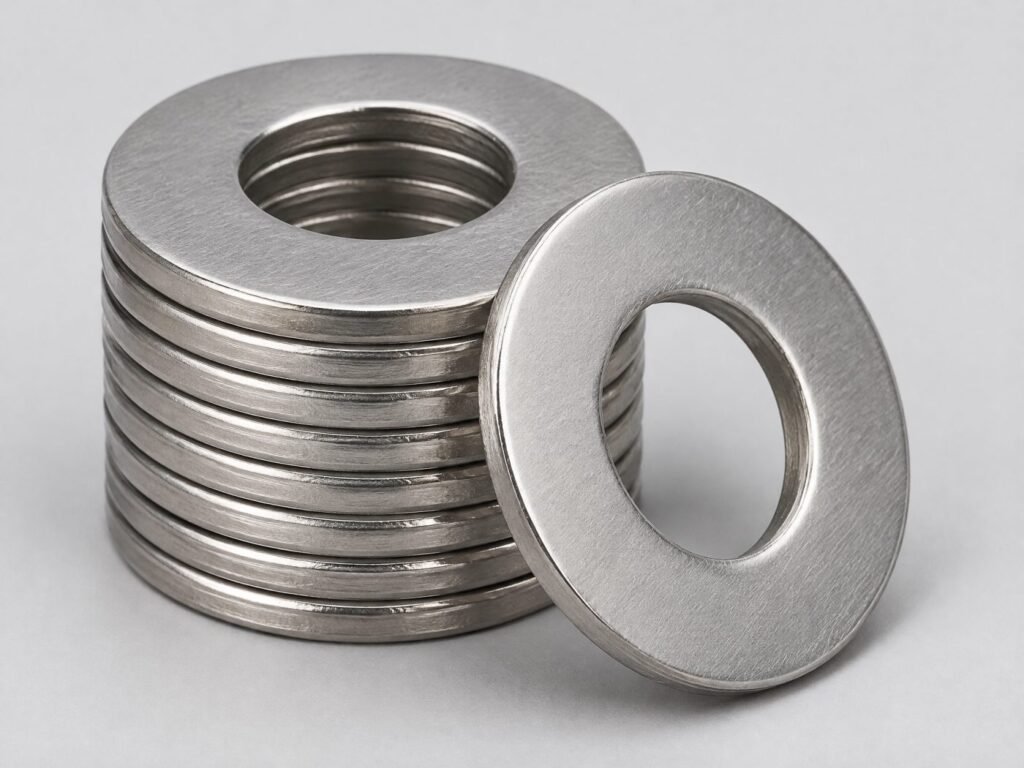
Short answer: A DIN 125 plain washer for M10 has a 10.5 mm inner diameter, 20 mm outer diameter and 2 mm thickness. The chart below gives M6 to M24 for DIN 125, and explains how DIN 127 spring washers differ. Always verify dimensions against the current standard before finalising a drawing or order.
What are the DIN 125 plain washer sizes?
DIN 125 is the common flat washer for metric bolts and screws. The size is named after the bolt it fits, and the inner diameter is slightly larger than the thread so the bolt passes freely. All values are in millimetres.
| Bolt size | Inner dia. (mm) | Outer dia. (mm) | Thickness (mm) |
|---|---|---|---|
| M6 | 6.4 | 12 | 1.6 |
| M8 | 8.4 | 16 | 1.6 |
| M10 | 10.5 | 20 | 2 |
| M12 | 13 | 24 | 2.5 |
| M16 | 17 | 30 | 3 |
| M20 | 21 | 37 | 3 |
| M24 | 25 | 44 | 4 |
These are nominal values for reference. Please verify them against the current edition of the standard, and see our DIN 125 page for more detail.
What is a DIN 127 spring washer?
DIN 127 covers the split spring washer, sometimes called a lock washer. It is a coil with a single cut and a slight twist. When the bolt is tightened, the washer is flattened and its spring action keeps tension against the nut or bolt head. That helps resist loosening from light vibration. It is sized by the bolt diameter, like a plain washer. Because the section and the spring form vary with the type specified, check the exact dimensions in the current standard or ask us to confirm them. Details are on our DIN 127 page.
How do I choose between a plain washer and a spring washer?
- Use a plain washer (DIN 125) when you need to spread the load over a larger area, protect a softer surface from the nut or bolt head, or bridge a slightly oversized hole.
- Use a spring washer (DIN 127) when the joint sees light vibration and you want extra resistance to loosening.
- Use both in many assemblies: a plain washer against the surface and a spring washer under the nut.
Spring washers are not a fix for a badly designed joint, so for heavy vibration consider other locking methods.
Which stainless grade should my washers be?
Match the washer to the bolt and nut. Mixing grades in one joint is best avoided. SS 304 is the general choice, SS 316 suits marine, coastal and chemical environments, and SS 202 is available for lighter-duty uses. We supply both stainless plain washers and stainless spring washers in metric and inch series.
What should I include when I order washers?
- Standard number (DIN 125 or DIN 127, or ISO or BS equivalent)
- Size, grade and finish
- Quantity and packing needs
- Material test certificate requirement, if any
How do I read the chart when selecting a washer?
Start with the bolt size, since every washer is named after it. Check the inner diameter first: it should be just larger than the thread, which is why an M10 washer has a 10.5 mm hole and not 10 mm. Then look at the outer diameter, which tells you how much load-spreading area you get. An M12 DIN 125 washer, for example, has a 24 mm outer diameter, roughly twice the thread diameter. Finally, check thickness against the space you have. Stacking a thicker washer under a head may change the grip length, so you may need a longer bolt.
If your joint uses a slotted or oversized hole, a plain washer with a larger outer diameter than the standard one may be needed. That is a common reason to order a non-standard washer made to drawing.
When comparing washers from different suppliers, make sure you are comparing the same standard and the same series. Inch series washers follow different dimensions from metric ones, and a part that looks similar may not fit your bolt properly.
One more practical point: washers are cheap, but a wrong one can ruin a joint. Always confirm the size on the bolt, the standard on your drawing and the grade before ordering, and keep a sample on file for repeat purchases so later batches match.
Frequently asked questions
Why is the washer hole bigger than the bolt size?
The clearance lets the bolt pass through easily. For an M10 bolt the DIN 125 washer has a 10.5 mm hole.
Can I use a DIN 125 washer with an M12 bolt that is in a larger hole?
Yes, a plain washer is often used to spread the load over a larger hole, but select the outer diameter to cover the hole edge properly. If in doubt, send us your drawing.
Do you make washers outside the standard sizes?
Yes. Non-standard washers can be made to drawing or sample. See our services page for how this works.
Ready to move forward? Send us your details and request a quote, or call +91 89196 74214 or email ayrssnutbolt@gmail.com.