
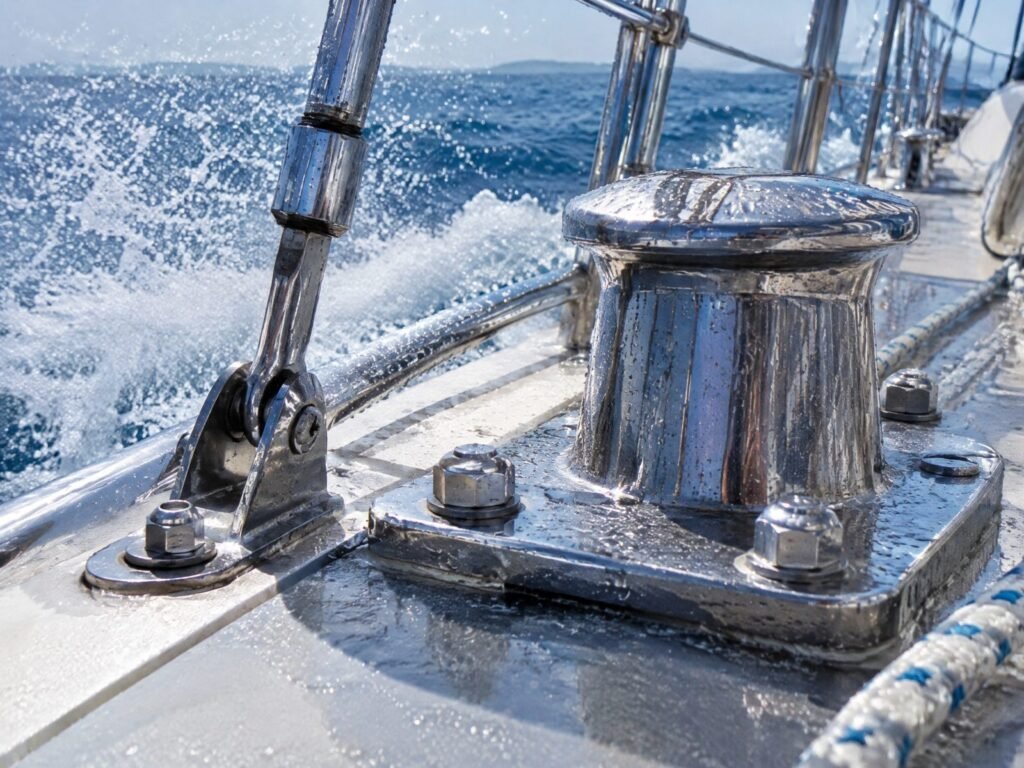
Short answer: Stainless steel bolts rust when their protective chromium oxide layer is damaged or cannot form. The usual causes are chlorides (salt, coastal air, bleach), iron particles picked up from tools or nearby steel, crevices that starve the surface of oxygen, and choosing a grade with too little corrosion resistance for the environment.
How does stainless steel normally resist rust?
Stainless steel contains at least about 10.5 percent chromium. Chromium reacts with oxygen to form a thin, invisible, self-repairing oxide film. As long as this film stays intact and oxygen can reach it, the metal underneath is protected. Rust appears when the film is broken faster than it can heal.
What is tea staining?
Tea staining is a light brown discolouration on the surface of stainless steel, most common outdoors near the sea. It is mainly cosmetic. It forms when salt deposits, moisture and pollution attack small spots on the surface, leaving a brown film that looks like rust. It often wipes off, but if ignored it can lead to real pitting.
What causes stainless steel bolts to rust?
1. Chloride attack
Chlorides in sea spray, road salt, swimming-pool areas and cleaning chemicals break down the passive film locally. This causes pitting, small deep holes that start from a surface spot. SS 316 resists this better than SS 304 because it contains molybdenum.
2. Iron contamination
Steel particles from grinding wheels, wire brushes, cutting tools or neighbouring carbon steel can embed in a stainless surface. These particles rust and the stain spreads. The stainless itself is fine, but the surface needs cleaning.
3. Crevice corrosion
Under washers, in threads and beneath gaskets, oxygen is limited, so the passive film cannot repair itself. Moisture and chlorides collect in the gap and corrosion starts. Fasteners are full of crevices, which is why they often show problems before flat panels do.
4. The wrong grade
An SS 202 or SS 304 bolt used in a marine or chemical setting may corrode where SS 316 would not. Match the grade to the environment.
5. Poor surface finish
Rough or burnt surfaces trap contaminants. Clean, smooth parts resist staining better, and passivation can help restore the surface.
| Cause | What you see | Fix |
|---|---|---|
| Chlorides | Pits, brown spots | Use SS 316, rinse regularly |
| Iron contamination | Orange rust dots | Clean, passivate, use stainless-only tools |
| Crevice | Staining under washers | Design for drainage, seal gaps |
| Wrong grade | General rusting | Upgrade grade |
| Tea staining | Light brown film | Clean with mild cleaner and rinse |
How do you remove rust stains from stainless steel bolts?
- Wash with warm water and a mild detergent to remove salt and dirt.
- Use a non-abrasive cloth or a nylon pad. Avoid carbon steel wire brushes.
- For stubborn stains, use a cleaner made for stainless steel, following its instructions.
- Rinse thoroughly and dry.
- If staining returns quickly, consider passivation or a higher grade.
How can you prevent rust on stainless steel fasteners?
- Choose SS 316 fasteners for coastal, marine and chemical settings.
- Keep stainless away from grinding dust and carbon steel contact during installation.
- Rinse exposed bolts with fresh water now and then in salty environments.
- Specify passivation where the application needs it.
- Avoid designs that trap water around the fastener.
- Do not mix dissimilar metals without isolation, since galvanic corrosion can add to the problem.
Is a rusty stainless bolt still safe to use?
Light surface staining usually does not weaken the bolt. Pitting, cracks or deep corrosion in the threads do. If a bolt is load-bearing and shows pitting, replace it. For general guidance on environments, see our industries page.
When is it the grade, not the care?
If SS 304 bolts rust within a short time in a coastal or chemical location, the grade is likely too low for the job. Moving to SS 316 is usually the practical step. Our SS 304 and SS 316 ranges are both made in our own unit, so you can compare them for your use.
How does the environment change the risk?
Corrosion risk rises with chloride level, temperature, humidity and how long the surface stays wet. A bolt on an inland roof sees rain but little salt. A bolt on a jetty sees salt spray, wind and sun, and a bolt in a cleaning-chemical area sees constant exposure to chlorine-based agents. Because the same grade behaves differently in each setting, always describe the site, not just the load, when choosing fasteners.
What should you check when staining keeps coming back?
- Is the bolt really the specified grade, or has a lower grade been supplied by mistake?
- Are carbon steel parts rubbing on or sitting above the stainless, dropping rust?
- Is water trapped under the head, washer or nut?
- Are cleaning agents containing chlorides splashing onto the bolts?
- Was the surface contaminated during cutting or grinding?
Working through this list usually finds the cause, and the fix is often simple, such as a drainage gap, a stainless-only brush or a switch to a higher grade.
Key takeaways
- Stainless rusts when its chromium oxide layer is damaged or starved of oxygen.
- Chlorides, iron contamination, crevices and wrong grade are the main causes.
- Tea staining is mostly cosmetic and can usually be cleaned.
- SS 316 resists chlorides better than SS 304.
- Replace load-bearing bolts that show pitting.
Ready to source? Send your grade, size, standard and quantity through our enquiry page, and we will confirm availability, standards and the documents we can provide before you order. You can also call +91 89196 74214 or email ayrssnutbolt@gmail.com.
Related products and guides
Frequently asked questions
Does tea staining mean my stainless bolt is failing?
Not usually. Tea staining is mainly cosmetic, a light brown film caused by salt, moisture and pollution on the surface, and it often wipes off. If ignored in a marine setting it can lead to pitting, so clean it and consider SS 316.
Why do new stainless bolts show orange rust dots?
Usually iron contamination, where steel particles from grinding wheels, wire brushes, tools or nearby carbon steel embed in the surface and rust. The stainless itself is fine. Clean the surface, passivate if needed, and use stainless-only tools.
Is SS 316 completely rust-proof?
No. SS 316 resists chlorides and pitting better than SS 304 because of its molybdenum content, but it can still stain or corrode in harsh conditions, especially in crevices. Rinse exposed bolts, avoid water traps, and check the exact environment.
Can I use a steel wire brush to clean stainless bolt stains?
No. Carbon steel brushes leave iron particles that rust and spread stains. Use warm water, mild detergent and a non-abrasive cloth or nylon pad, or a cleaner made for stainless steel, then rinse and dry thoroughly.
Related pages
The protective chromium oxide layer is probably damaged. Common causes are salt or chlorides, iron particles from tools, trapped moisture in crevices, or using a grade such as SS 304 or 202 where SS 316 is needed. Identify the cause before choosing a fix.
Tea staining is a brown surface discolouration that appears on stainless steel, especially near the sea. It is mostly cosmetic and often wipes off with a mild cleaner, but it signals that salt and moisture are attacking the surface.
SS 316 resists rust and chloride pitting better than SS 304 because of its molybdenum content, but it is not immune. In severe or poorly drained conditions it can still stain or corrode. Regular cleaning and good drainage design still matter.
Surface rust and tea staining can often be cleaned off and the surface passivated. Bolts with pitting, cracks or damaged threads should be replaced, especially where they carry load or hold safety-critical parts. Always find the cause first, or the problem will return.