
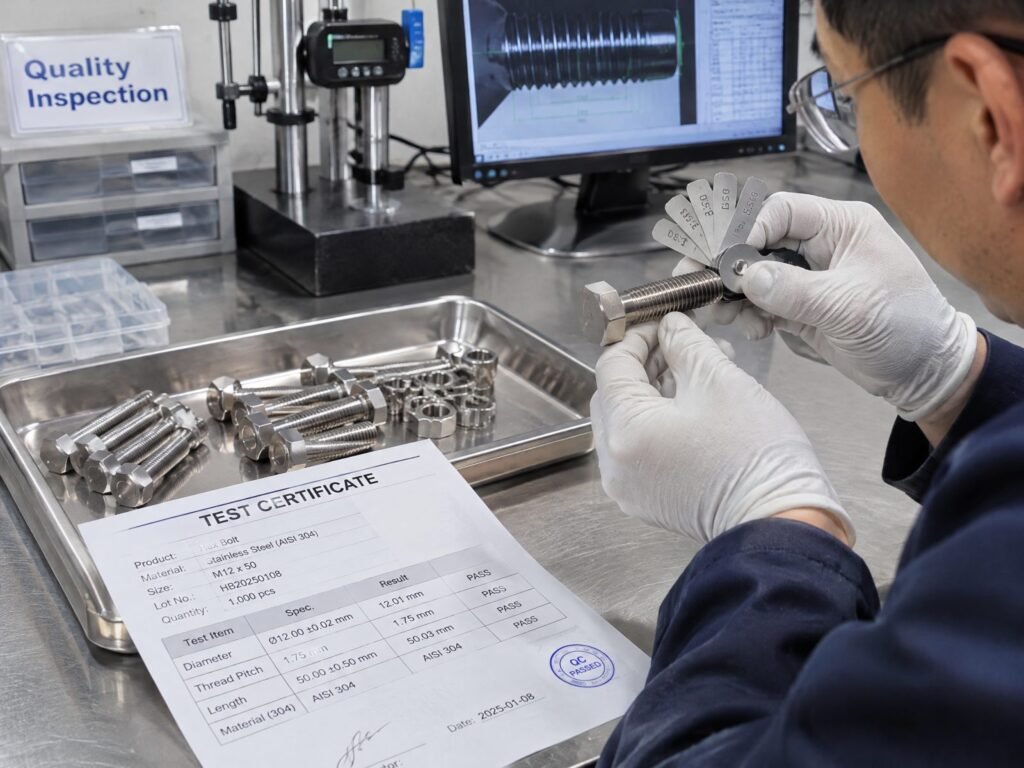
Short answer: SS 304 is the general-purpose grade, SS 316 adds molybdenum for better corrosion resistance, SS 202 is a lower-nickel economy grade, and SS 410 is a hardenable martensitic grade chosen for strength and wear rather than corrosion resistance. The chart below shows how they compare.
Choosing the wrong grade is one of the most common and costly fastener mistakes. A bolt that is too weak in corrosion resistance rusts; one that is over-specified wastes budget. This chart helps you narrow down the choice before you send an enquiry.
What is the stainless steel fastener grades chart?
The table gives typical characteristics. Exact composition limits come from the material standard, so treat these as general guidance, not a guarantee.
| Feature | SS 304 | SS 316 | SS 202 | SS 410 |
|---|---|---|---|---|
| Family | Austenitic | Austenitic | Austenitic | Martensitic |
| Main alloying | About 18% chromium, 8% nickel | Chromium, nickel, 2-3% molybdenum | Chromium, lower nickel, higher manganese | About 12% chromium, little nickel |
| Corrosion resistance | Good | Very good, best for chlorides | Moderate | Lower |
| Magnetic | Slightly after cold work | Slightly after cold work | Slightly after cold work | Yes |
| Heat treatable to harden | No | No | No | Yes |
| Relative cost | Medium | Higher | Lower | Lower to medium |
When should you choose SS 304?
Choose SS 304 for general fabrication, machinery, indoor installations, enclosures and outdoor use away from the coast. It is the most widely used fastener grade because it balances corrosion resistance, availability and cost. It corresponds to the A2 group in ISO 3506. See our SS 304 fasteners page for the range we make.
When should you choose SS 316?
Choose SS 316 for marine, coastal, chemical, food and pharmaceutical environments, where chlorides or aggressive cleaning agents attack lesser grades. Molybdenum gives it better resistance to pitting. It corresponds to the A4 group. Details are on our SS 316 fasteners page, and we compare the two in SS 304 vs 316.
Where does SS 202 fit?
SS 202 replaces part of the nickel with manganese, which lowers cost. It suits dry, indoor and light-duty uses where appearance matters and corrosion exposure is low. It is not a good choice for marine, wet or chemical settings. Where long life outdoors matters, step up to 304 or 316. Because 202 is less resistant to corrosion, always check the environment before choosing it.
What is SS 410 used for?
SS 410 is a martensitic stainless steel. It can be heat treated to high hardness and strength, so it is used for parts that need wear resistance or higher strength, such as some pins, shafts and certain fasteners. It resists corrosion less well than austenitic grades and is magnetic. Treat it as a strength grade, not a corrosion grade. Availability depends on the supplier, so ask before specifying it.
How do you pick the right grade quickly?
- Identify the environment: dry indoor, outdoor inland, coastal, or chemical.
- Identify the load: standard or higher strength.
- Decide the budget limit and the cost of failure.
- Match the grade using the table above.
- Confirm the property class and standard with your supplier.
| Environment | Usual starting grade |
|---|---|
| Dry indoor, light duty | SS 202 or SS 304 |
| General indoor and inland outdoor | SS 304 |
| Coastal, marine, chemical, washdown | SS 316 |
| High wear or hardness needed | SS 410 (confirm availability) |
Why is the grade not the whole story?
Grade tells you the alloy, but strength depends on the property class under ISO 3506, such as 50, 70 or 80, and fit depends on the dimensional standard. A complete specification names the grade, the property class and the standard. Our technical data page covers these basics.
Does finishing change the grade?
No, but finishing affects performance. Passivation removes free iron from the surface and helps the natural protective layer form. It does not turn a lower grade into a higher one. Read more in our guide to passivation.
What about low-carbon variants like 304L and 316L?
The L suffix means low carbon. These variants reduce the risk of carbide formation during welding, which can weaken corrosion resistance near weld zones. They matter mostly for welded fabrication. For ordinary bolted joints, standard 304 and 316 are the usual choices. If your assembly involves welding near the fasteners, mention it in the enquiry.
How does temperature affect grade choice?
Austenitic grades such as 304 and 316 keep their toughness at low temperatures and handle moderate heat well. At sustained high temperatures, scaling and loss of strength become concerns, so very hot service needs a specialist review rather than a guess. Share the operating temperature range with your supplier if it is unusual.
A final point on grades: always buy against a written specification instead of a casual description like “good quality stainless”.
How should you request a grade from a supplier?
Write the grade by name, the property class and the standard in the same line, for example SS 316, A4-70, with the size and thread. If you are unsure which grade suits the job, describe the environment and load instead and ask the supplier to recommend, then confirm the choice in writing before the order.
Key takeaways
- SS 304 is the all-round choice; SS 316 is for chlorides and harsh chemistry.
- SS 202 is an economy grade for dry, low-exposure use.
- SS 410 is a hardenable, magnetic grade chosen for strength, not corrosion resistance.
- Grade, property class and standard must all be stated in an enquiry.
- Do not use a cheaper grade only to save cost in a corrosive setting.
We make stainless steel fasteners in SS 304, SS 316 and SS 202. If you need another grade, tell us in your enquiry and we will confirm what we can supply. Send your requirement through the enquiry page.
Related products and guides
Frequently asked questions
Is SS 410 magnetic?
Yes. SS 410 is a martensitic stainless steel and is magnetic, unlike austenitic grades 304, 316 and 202, which are only slightly magnetic after cold work. Its corrosion resistance is lower, so treat it as a strength grade rather than a corrosion grade.
Which stainless grade is best for coastal fasteners?
SS 316 is the usual choice, because its molybdenum content gives better resistance to chlorides and pitting. SS 304 may corrode in salt-laden air, and SS 202 and SS 410 are not suitable for marine settings.
Does the stainless grade decide bolt strength?
Not by itself. Grade tells you the alloy, while strength depends on the property class under ISO 3506, such as 50, 70 or 80, and fit depends on the dimensional standard. A full specification names the grade, class and standard.
Which grades correspond to A2 and A4 markings?
SS 304 corresponds to the A2 group in ISO 3506 and SS 316 to the A4 group. SS 202 is not part of the A2 or A4 groups. Always check the marking on the part against your order. Send your requirement for a quotation.
There is no single best grade. SS 304 suits general use, SS 316 suits marine, chemical and food environments, SS 202 suits dry light-duty use, and SS 410 suits high strength and wear needs. Choose by environment, load and the cost of failure.
No. SS 202 has lower nickel and higher manganese, so it costs less but resists corrosion less well than SS 304. It works for dry, indoor, light-duty applications. For outdoor, wet or coastal use, SS 304 or SS 316 is the safer choice.
Yes. SS 410 is a martensitic stainless steel and is magnetic. Austenitic grades such as 304 and 316 are non-magnetic when annealed but can become slightly magnetic after cold working. Magnetism alone cannot prove or disprove a grade.
SS 316 contains molybdenum, which gives better resistance to chlorides and pitting, so it suits marine and chemical settings. SS 304 is cheaper and fine for general use. Both are austenitic and correspond to A2 and A4 in ISO 3506.