
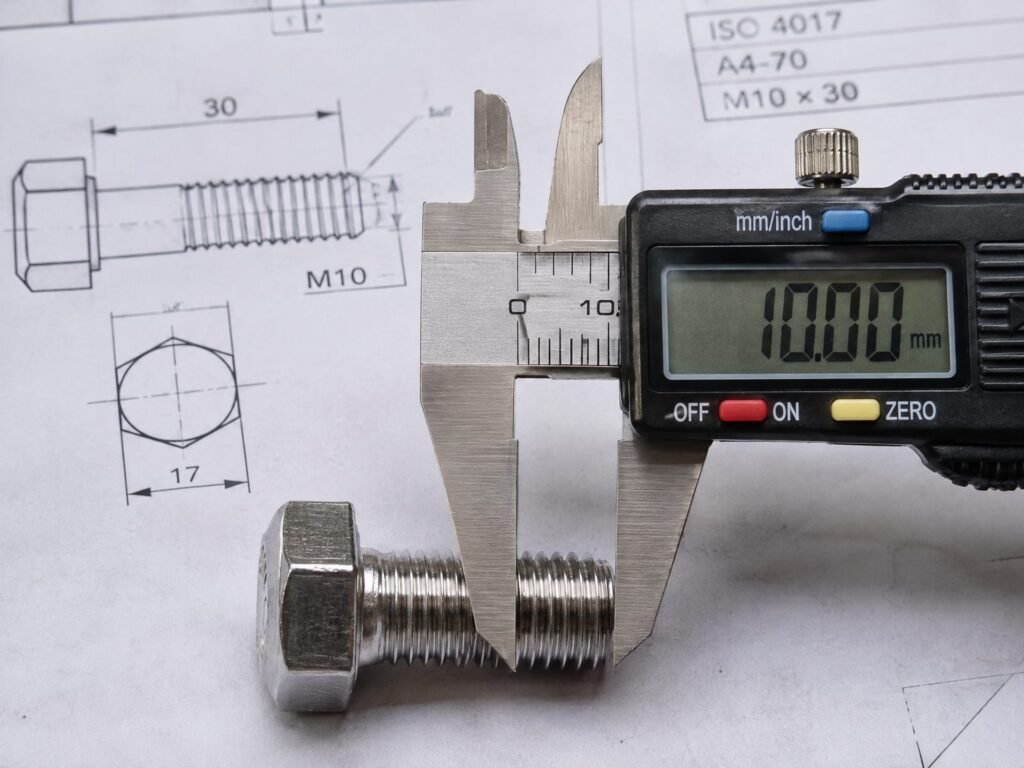
Short answer: To estimate the weight of an SS bolt, calculate its volume and multiply by the density of stainless steel, about 7.9 g/cm3. For a quick estimate, treat the shank as a cylinder and add a margin for the head. Treat the result as an estimate; actual weight depends on the head style, thread and tolerances.
What density should I use for stainless steel?
Use about 7.9 g/cm3 (7,900 kg/m3) for general estimates. Published values for stainless steels commonly fall between roughly 7.85 and 8.0 g/cm3, depending on the grade. Austenitic grades such as 304 and 316 are close to this range, with small differences from alloy content. For a quick weight check, 7.9 g/cm3 is a reasonable single figure.
Carbon steel is usually quoted at around 7.85 g/cm3, so stainless is a similar weight, only slightly heavier on average.
What is the basic formula?
For a cylindrical shank, the volume is the area of the circle multiplied by length:
- Volume = (pi / 4) x d x d x L
- Weight = Volume x Density
Keep units consistent. With diameter and length in millimetres, volume is in mm3; there are 1,000 mm3 in 1 cm3. Dividing mm3 by 1,000 gives cm3, and multiplying cm3 by 7.9 gives grams.
A shortcut in millimetres and kilograms is: weight in kg is approximately 0.0000062 x d x d x L. This is simply 0.7854 x 7.9 x 0.000001 worked out in advance.
Worked example: M10 x 50 bolt shank
This is an estimate for the shank only, treated as a plain cylinder with a 10 mm diameter and a 50 mm length.
- Convert to centimetres: diameter 1.0 cm, length 5.0 cm.
- Volume = 0.7854 x 1.0 x 1.0 x 5.0 = about 3.93 cm3.
- Weight = 3.93 x 7.9 = about 31 g.
So the cylindrical shank weighs roughly 31 g. A real M10 bolt also has a head, which adds weight, while the thread removes a little material compared with a full-diameter cylinder. The finished bolt will therefore weigh more than the shank figure. Use 31 g as a lower-bound starting point, not as a catalog weight.
How many pieces make up 1 kg?
Divide 1,000 g by the weight of one piece. Using the shank-only estimate of 31 g gives about 32 pieces per kg. Because the real bolt is heavier once the head is counted, the actual count per kg will be lower. For purchasing, always confirm piece weight from a specification or sample rather than relying on a rough estimate.
Why do catalog weight charts differ?
Weight charts from different sources rarely match exactly. Common reasons are below.
| Reason | Effect on weight |
|---|---|
| Head style and size | Hex, allen cap and countersunk heads have different volumes; the standard sets the head dimensions |
| Thread type | Full thread and partial thread bolts differ, and thread form removes material from the shank |
| Standard used | DIN and ISO dimensions can differ slightly, for example across-flats of the hex head |
| Tolerances | Dimensions can sit anywhere within the allowed range, so real pieces vary |
| Density assumed | One chart may use 7.85 g/cm3 and another 7.93 or 8.0 |
| Finish and rounding | Charts round values, and some include or exclude nuts and washers |
How do I estimate nuts and washers?
The cylinder method does not fit nuts or washers well. For a washer, estimate it as a thin ring: area of the outer circle minus area of the hole, multiplied by thickness and density. For a nut, a hexagonal prism minus the threaded hole is a rough approximation. For accurate figures, use the published weight tables for the standard, or ask for a sample weight. Our SS hex nuts are available in a range of sizes.
How does weight matter when buying?
Weight matters for freight cost, packing and for comparing quotes given by the kilogram versus by the piece. If one supplier quotes per kg and another per piece, convert both to the same basis using the per-piece weight. Price is also not driven by weight alone: grade, finish, standard and quantity all play a part. For bolt dimensions and standards, see our SS hex bolts and the technical data page.
Estimate or exact: which should I use?
Use the formula for planning, budgeting freight and checking whether a quoted weight is plausible. Use the standard’s published weights or a measured sample when the number affects billing, shipping documents or compliance. Always say whether a weight is theoretical or measured, so that both sides of the order read the same figure the same way.
Can I use the same method for studs and threaded rods?
Yes, with care. A stud or threaded bar is close to a plain cylinder along its full length, so the volume formula works well and the result is usually closer to the real weight than for a headed bolt. Use the nominal diameter and the cut length, then apply the density. Remember that thread form removes a little material, so the real piece can weigh slightly less than the estimate. Our SS studs are available in a range of lengths.
Key takeaways
- Stainless steel density is about 7.9 g/cm3, within roughly 7.85 to 8.0 depending on the grade.
- Weight is approximately (pi / 4) x d x d x L x density for a cylindrical shank.
- The M10 x 50 shank example gives about 31 g, an estimate that excludes the head.
- Catalog weights differ because of head style, thread, standard, tolerances and density assumption.
- Confirm weights from a standard or sample when accuracy matters.
Need exact sizes and weights for your project? Send your specification through our enquiry page and request a quote.
Frequently asked questions
How do I convert bolt weight in kg to number of pieces?
Divide 1,000 grams by the weight of one piece to get pieces per kg. For example, a 31 g piece gives about 32 pieces. Use a catalogue or sample weight rather than a rough estimate, since head style and thread change the real weight.
Is a stainless steel bolt heavier than a carbon steel bolt of the same size?
Only slightly. Stainless is usually quoted at about 7.9 g/cm3, while carbon steel is around 7.85 g/cm3, so bolts of the same size weigh very nearly the same. Differences between stainless grades are small and come from alloy content.
Does an SS 316 bolt weigh more than an SS 304 bolt of the same size?
The difference is very small. Both austenitic grades fall within the commonly published density range of roughly 7.85 to 8.0 g/cm3, so a single figure of 7.9 g/cm3 works for practical estimating. Head style and tolerances affect weight more than the grade does.
Why is my estimated bolt weight different from the supplier's weight chart?
Charts differ in head dimensions, thread form, density assumed and rounding. A shank-only cylinder estimate leaves out the head, so it comes out lower than the real bolt. Use the published weight table for the specific standard, or ask for a sample weight to confirm.
Related pages
Use about 7.9 g/cm3 for general estimates. Published values for stainless steels range roughly from 7.85 to 8.0 g/cm3 depending on the grade, so 7.9 is a reasonable working figure for 304 and 316.
Treat the shank as a cylinder: volume equals pi divided by 4, times diameter squared, times length. Multiply by 7.9 g/cm3. Then allow extra for the head. The result is an estimate; confirm with a standard or sample.
A cylinder estimate covers only the shank. The head adds weight, and tolerances and the density value used also shift the result. Thread removes a little material, but the head usually outweighs that, so real bolts are heavier.
Charts may follow different standards such as DIN or ISO, assume different densities, use different head dimensions, round figures differently or cover full versus partial thread. Always check which standard and density a chart is based on.