If you buy hex bolts internationally, you will see DIN 931 and DIN 933 on almost every enquiry. They describe almost the same bolt with one key difference: how far the thread runs along the shank.
DIN 931: partial (half) thread
A DIN 931 bolt has a plain, unthreaded shank section below the head and the thread only on the end. The unthreaded shank is a little stronger in shear, because the full cross-section carries the load, and it can help locate parts in a joint. Choose DIN 931 where the joint is loaded sideways and the shank passes through the clamped parts.
DIN 933: full thread
A DIN 933 bolt is threaded all the way up to the head. This gives maximum thread engagement, which suits thin parts, tapped holes and joints where the bolt length is short. It is also the easier part to stock, because one length covers more situations.
Quick comparison
- DIN 931: partial thread, better for shear loads, longer bolts.
- DIN 933: full thread, flexible for short grip lengths and tapped holes.
- Both are available in SS 304, SS 316 and SS 202 in the metric series.
What to state on your order
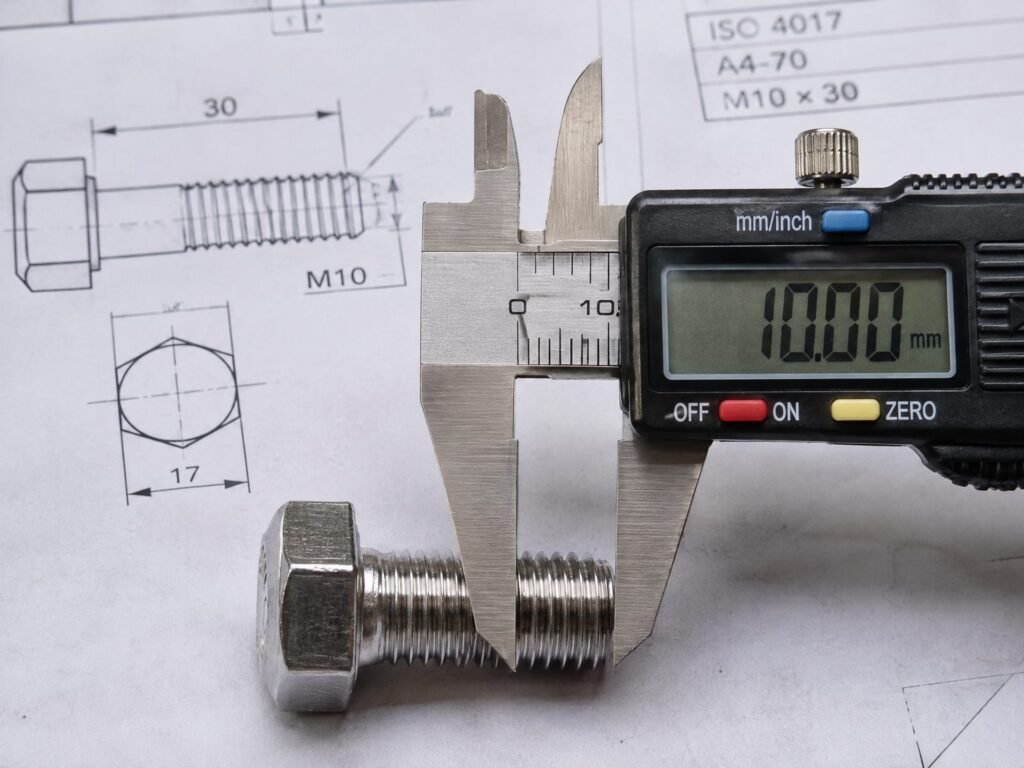
Always give the standard, diameter and length, grade and property class, for example: DIN 933 M10 x 40 mm, A2-70. Without the standard number a supplier has to guess the thread length. Related standards are ISO 4014 (partial thread) and ISO 4017 (full thread).
Browse our stainless steel hex bolts or send us your requirement for a quotation.